How to Determine 1 Tail or 2 Tailed Easy Way
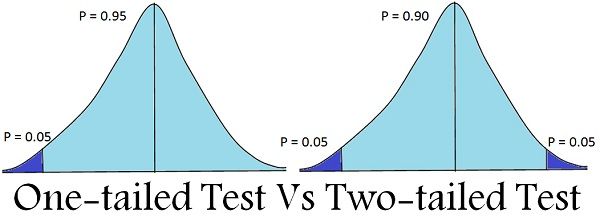 The ii ways of carrying out statistical significance test of a characteristic, fatigued from the population, with respect to the test statistic, are a one-tailed test and two-tailed examination. The one-tailed test refers to a test of naught hypothesis, in which the alternative hypothesis is articulated directionally. Hither, the critical region lies just on one tail. Withal, if the alternative hypothesis is not exhibited directionally, so it is known equally the two-tailed test of the null hypothesis., wherein the critical region is one both the tails.
To examination the hypothesis, test statistics is required, which follows a known distribution. In a exam, there are two divisions of probability density bend, i.eastward. region of acceptance and region of rejection. the region of rejection is chosen every bit a disquisitional region.
In the field of research and experiments, it pays to know the difference between one-tailed and two-tailed test, every bit they are quite ordinarily used in the process.
Content: Ane-tailed Test Vs Two-tailed Test
- Comparison Chart
- Definition
- Fundamental Differences
- Conclusion
Comparing Chart
| Basis of Comparison | One-tailed Exam | Two-tailed Test |
|---|---|---|
| Meaning | A statistical hypothesis test in which alternative hypothesis has only one end, is known as one tailed test. | A significance test in which alternative hypothesis has two ends, is called two-tailed test. |
| Hypothesis | Directional | Non-directional |
| Region of rejection | Either left or correct | Both left and right |
| Determines | If there is a relationship between variables in single direction. | If there is a human relationship between variables in either direction. |
| Outcome | Greater or less than certain value. | Greater or less than certain range of values. |
| Sign in culling hypothesis | > or < | ≠ |
Definition of One-tailed Examination
One-tailed test alludes to the significance test in which the region of rejection appears on one stop of the sampling distribution. Information technology represents that the estimated test parameter is greater or less than the critical value. When the sample tested falls in the region of rejection, i.east. either left or right side, equally the case may be, it leads to the credence of alternative hypothesis rather than the aught hypothesis. It is primarily applied in chi-square distribution; that ascertains the goodness of fit.
In this statistical hypothesis test, all the critical region, related to α, is placed in any one of the two tails. I-tailed examination can be:
- Left-tailed test: When the population parameter is believed to be lower than the causeless one, the hypothesis examination carried out is the left-tailed test.
- Right-tailed test: When the population parameter is supposed to be greater than the causeless one, the statistical test conducted is a right-tailed exam.
Definition of Two-tailed Exam
The two-tailed test is described as a hypothesis exam, in which the region of rejection or say the critical area is on both the ends of the normal distribution. It determines whether the sample tested falls inside or exterior a sure range of values. Therefore, an alternative hypothesis is accustomed in identify of the null hypothesis, if the calculated value falls in either of the two tails of the probability distribution.
In this test, α is bifurcated into two equal parts, placing one-half on each side, i.eastward. information technology considers the possibility of both positive and negative furnishings. Information technology is performed to see, whether the estimated parameter is either above or beneath the assumed parameter, so the extreme values, piece of work as bear witness against the null hypothesis.
Key Differences Between One-tailed and Two-tailed Test
The fundamental differences between one-tailed and two-tailed test, is explained below in points:
- One-tailed exam, as the name suggest is the statistical hypothesis examination, in which the alternative hypothesis has a unmarried end. On the other hand, two-tailed exam implies the hypothesis test; wherein the alternative hypothesis has dual ends.
- In the ane-tailed test, the alternative hypothesis is represented directionally. Conversely, the two-tailed examination is a non-directional hypothesis test.
- In a one-tailed test, the region of rejection is either on the left or correct of the sampling distribution. On the contrary, the region of rejection is on both the sides of the sampling distribution.
- A one-tailed test is used to define if there is any relationship between variables in a single direction, i.e. left or right. Equally against this, the two-tailed test is used to identify whether or not there is any relationship between variables in either direction.
- In a one-tailed test, the test parameter calculated is more or less than the disquisitional value. Unlike, two-tailed test, the issue obtained is within or exterior critical value.
- When an alternative hypothesis has '≠' sign, then a two-tailed test is performed. In dissimilarity, when an alternative hypothesis has '> or <' sign, and so i-tailed test is carried out.
Conclusion
To sum up, we can say that the basic difference between one-tailed and two-tailed test lies in the direction, i.e. in case the inquiry hypothesis entails the management of interrelation or difference, and so one-tailed examination is applied, just if the research hypothesis does not signify the direction of interaction or difference, we use two-tailed test.
felicianowhissent.blogspot.com
Source: https://keydifferences.com/difference-between-one-tailed-and-two-tailed-test.html
0 Response to "How to Determine 1 Tail or 2 Tailed Easy Way"
Post a Comment